One Child. One Ecosystem. Multiple Points of Transformation.
Imagine throwing a pebble into a still pond. The pebble hits the water and creates a ripple. Then another. And another. Each one moves farther away from the center.
Now imagine that the pebble is your child and the first ripple is you—the parent and family.
You are your child’s first environment. Before there is a teacher, coach, best friend, employer, or social media account, there is home. And home is already teaching. Your child is learning what respect looks like, how adults and children communicate, what happens when someone makes a mistake, how problems are handled, and what is expected of them. Some of those lessons you teach intentionally. Others you don’t even realize you’re teaching.
But the ripples don’t stop at home. As your child grows, so does the ecosystem.
Family → Friends → School → Activities → Social Media → Relationships → Work → Community → The World
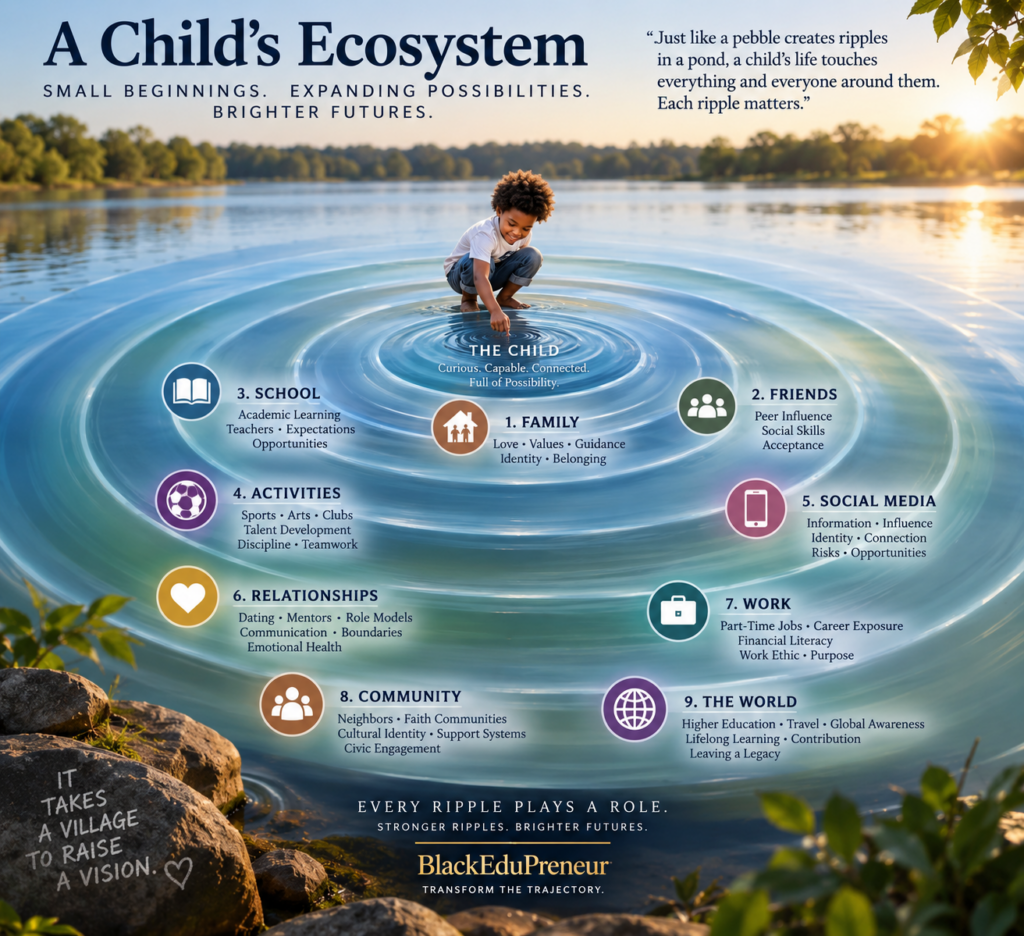
With every new ripple come new people, expectations, influences, and decisions that you will not always be there to help your child navigate. That’s why parenting cannot simply be about controlling what happens in the first ripple. We have to prepare our children for everything that comes after it.
Eventually, Other Voices Will Compete With Yours
When children are little, parents control much of their world. Then the world gets bigger. Friends begin influencing what they think. Teachers have expectations. Social media introduces values we may never have taught. Eventually come relationships, work, money, and adult decisions with adult consequences.
Little by little, something changes. You are still their parent, but you are no longer standing in the middle of every decision. If the primary lesson we have taught our children is to obey us, they may be unprepared for the moment when we aren’t there to tell them what to do. That is why critical thinking, self-regulation, judgment, and character matter.
The goal was never simply to control the child while they were inside our ripple. The goal is to prepare the child to navigate every ripple that comes after us.
Black Children Are Not Entering a Neutral Ecosystem
This is where context matters. Black children develop through the same human processes as every other child, but they are not growing up outside of American history, Black culture, race, or the experiences of the generations raising them. And sometimes what we teach our children in one ripple can collide with what another adult expects from them in the next.
Consider something as simple as eye contact. Many Black children have been taught that staring directly into an adult’s eyes while being corrected is disrespectful. Some have also learned that responding while an adult is admonishing them is considered “talking back.” So the child looks down and remains quiet.
Then that child enters a classroom where a teacher may expect exactly the opposite: “Look at me when I’m talking to you.” “Answer me when I ask you a question.”
The child may believe he is showing respect. The teacher may believe he is being disrespectful. Same child. Same behavior. Two different interpretations. The child is simply carrying a lesson learned in one ripple into the next.
This is only one example, but it illustrates something Black parents cannot afford to ignore. Our children will move through environments that may not always understand the cultural rules, behaviors, communication patterns, or experiences they bring with them. We have to prepare them to navigate those differences without teaching them that something is wrong with who they are.
What We Carry Enters the First Ripple Too
Parents don’t enter parenthood as blank slates. We parent from somewhere.
Long before we had children of our own, we were somebody’s child. We learned what respect looked like, what happened when we disobeyed, whether children were allowed to question adults, how discipline was handled, and what was expected of a “good child.” Those experiences became part of what we know about parenting.
Sometimes we consciously decide to repeat what our parents did because we believe it worked. Sometimes we deliberately do the opposite because we remember how something made us feel. And sometimes we repeat a practice without ever making a decision at all. We simply parent from what we know.
That matters because the parenting practices we inherited were developed inside an ecosystem too. Our parents were preparing us for the world they understood. Their parents prepared them for theirs. And generations of Black parents developed ways of raising children under circumstances where obedience, respect for authority, staying out of trouble, and knowing your place could have very real consequences for a child’s safety.
But the ecosystem kept changing. And sometimes our parenting practices didn’t change with it.
We can find ourselves using an old strategy inside a new environment without ever stopping to ask whether it is still producing what our children need. That doesn’t mean everything we inherited should be discarded. Some things should absolutely be preserved. But “that’s how I was raised” cannot be the only reason we keep raising children that way.
We have to understand where a practice came from, what it was designed to accomplish, and whether it is preparing our children for the world they are actually entering.
The Child Is Only Part of What We Need to See
When a child begins struggling, our attention naturally goes directly to the behavior, the grades, or the choices that have become impossible to ignore. But the child is not developing in isolation.
A behavior problem in school may have begun with an academic struggle that they didn’t know how to communicate. Something considered disrespectful at school may have been taught as respect at home. And the way a parent responds to either situation may be influenced by lessons learned decades earlier in their own childhood.
This is how our past can be operating in the present without us even recognizing it.
This is why we have to look beyond what the child is doing and consider what is happening around the child. Instead of looking only at the child and asking, “What’s wrong with him?”, we need to ask a different question:
“What is happening in the ecosystem surrounding this child—and what are each of us bringing into it?”
That question changes what we see. It certainly changed what I saw, and ultimately, it changed the way I approached my work.
BlackEduPreneur Works Across the Ripples
After decades of working with children and families, I stopped seeing these as separate problems. I began seeing different needs within the same child’s ecosystem. And that is why BlackEduPreneur doesn’t address only one part of a child’s development.
Sometimes the work begins with the adult. Before we can become intentional about what we pass forward, we may need to understand the experiences, beliefs, wounds, and generational patterns that shaped us.
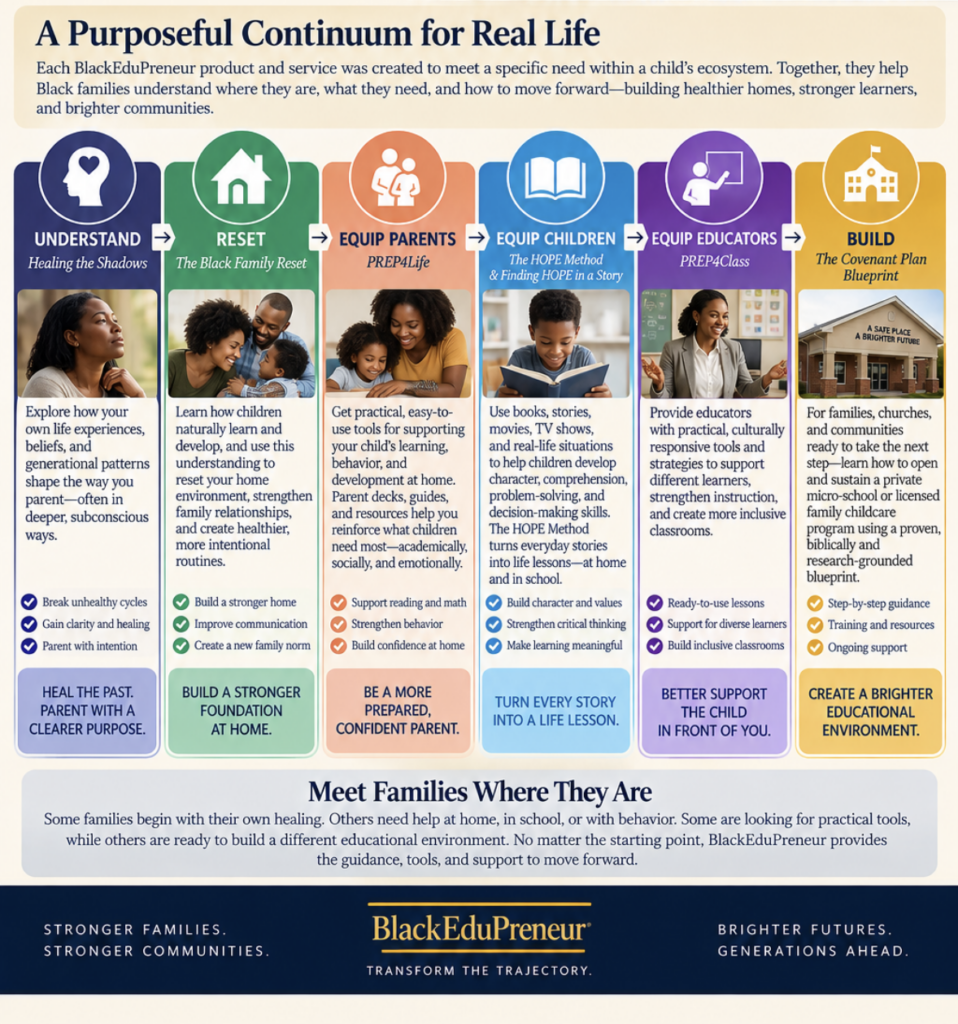
UNDERSTAND — Healing the Shadows
Sometimes the work is within the family. We need to decide what we want to preserve, what needs strengthening, what needs to change, and what needs to end with us.
RESET — The Black Family Reset
Sometimes parents need practical tools for supporting their child’s learning, behavior, and development.
EQUIP PARENTS — PREP4Life
Sometimes our children need to be intentionally taught the things we keep assuming they will somehow develop on their own—character, comprehension, problem-solving, self-control, judgment, and decision-making.
EQUIP CHILDREN — The HOPE Method + Finding HOPE in a Story
Sometimes the need extends into the classroom, where educators need better tools for recognizing different learners, responding to individual needs, and teaching the child in front of them.
EQUIP EDUCATORS — PREP4Class
And sometimes families and communities determine that changing what happens at home is not enough. They want greater control over the educational environment itself.
BUILD — The Covenant Plan Blueprint
These aren’t unrelated products. They address different needs within the same child’s ecosystem. Not every family needs every part, and not every family begins in the same place. A parent may come to us because a child is struggling in school. Another may need support with behavior at home. A church or community organization may want to strengthen families or develop young people’s character and decision-making. An educator may need better tools for reaching children who learn differently. And another family or community may be ready to create a different educational environment.
Different starting points. Different needs. Same child. Same ecosystem.
The Ripples Will Keep Growing
We cannot stop our children’s worlds from getting bigger, nor should we. Our job is not to keep them in the first ripple forever. Our job is to prepare them for the ones we know are coming.
Eventually, our children will encounter people we don’t know, ideas we didn’t teach, situations we didn’t anticipate, opportunities we couldn’t create, and decisions we cannot make for them. When that happens, what will matter is what we developed in them while we had the greatest influence.
That is why BlackEduPreneur works across the continuum—from understanding the experiences parents carry, to strengthening what happens within the family, to intentionally developing the child, to supporting the educators who teach them, and, when necessary, helping families and communities create different educational environments.
The child is still at the center.
The ripples just keep getting larger.
And as the ripple gets larger, so must our thinking.